What You Wear to the Server Matters More Than You Think
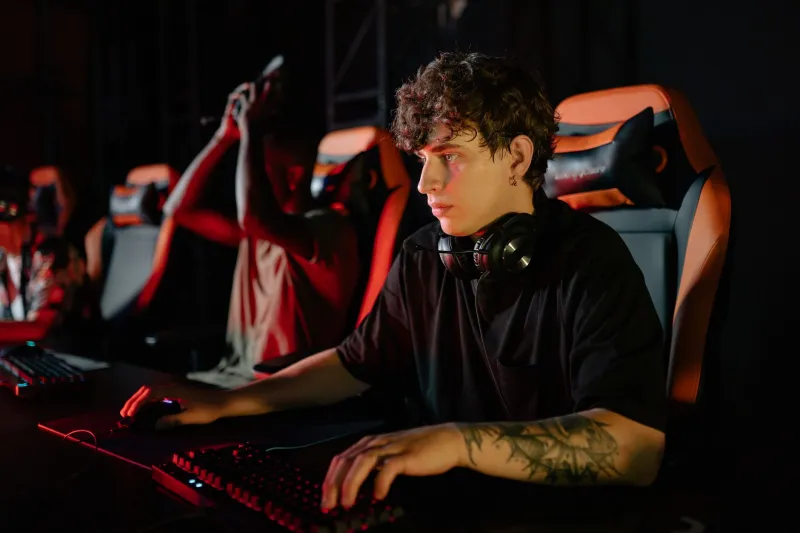
Here's a question nobody's asking in the hardware forums: did you get dressed before you queued up this morning?
Not just rolled out of bed and opened the client. Actually got dressed. Put on something with intention. Maybe even looked in the mirror for a second before dropping into ranked.
If that sounds ridiculous to you, you're in good company. The competitive gaming world has spent years treating personal style as irrelevant noise — something for streamers to worry about for the camera, not for players who are actually trying to win. Comfort over everything. Hoodies for life. Who cares what you're wearing when nobody can see you?
Except that logic has a pretty significant flaw, and it's one that sports science figured out a while ago.
The Science Has a Name, and It's Kind of Perfect
Enclothed cognition. It's the psychological phenomenon where the clothes you wear influence your mental state — not just how others perceive you, but how you perceive yourself. The term was coined by researchers Hajo Adam and Adam Galinsky in a 2012 study that found people wearing lab coats performed better on attention-focused tasks than those who weren't. The coat itself didn't do anything. The meaning attached to wearing it did.
Now apply that to esports. If you sit down in the same oversized sleep shirt you've been wearing since Tuesday, your brain registers that as casual mode. Low stakes. Chill session. But if you've got on a clean jersey, a fitted hoodie you actually like, or even just an outfit you feel sharp in? The internal signal shifts. You're telling your own nervous system that this is go time.
"The relationship between dress and performance is well-documented in traditional sports," says Dr. Kayla Ostrowski, a performance psychologist who's worked with collegiate esports programs. "Athletes use pre-competition rituals — including what they wear — to enter a focused, competitive mental state. There's no reason that mechanism stops working just because the competition is digital."
What the Pros Are Actually Doing
Spend enough time around competitive players and you start noticing patterns. The ones who treat their career like a profession tend to treat their appearance the same way.
Take the pre-match locker room energy at LAN events. Players aren't just warming up their mechanics — they're putting on their team jerseys, checking how they look on camera, making deliberate choices about how they present. That's not vanity. That's ritual. And ritual is one of the most powerful focus tools in competitive sport.
Valoriant IGL and content creator Marcus "Flux" Delgado, who competes on the collegiate circuit out of Austin, Texas, described his approach this way: "I have a specific outfit I wear when I'm grinding ranked seriously. It sounds dumb but it genuinely puts me in a different headspace. Like, I'm not just playing — I'm competing. The fit is part of that switch."
 Photo: Austin, Texas, via wallpapers.com
He's not alone. Across Twitch and YouTube, some of the most consistent performers have developed what you might call a competitive wardrobe — clothes that signal to their own brain, and to their audience, that what's about to happen is intentional.
The Team Cohesion Angle Nobody Talks About
Here's where it gets interesting beyond individual psychology: matching or coordinated fits within a team setting actually build cohesion. Again, this isn't a gaming-specific discovery — it's why sports teams wear uniforms in the first place. The visual unity creates a psychological "we" that's harder to manufacture through voice comms alone.
Several amateur esports programs in the US have started requiring players to wear team merch during scrimmages and practice sessions, not just at tournaments. The reasoning is straightforward: if you look like a unit, you start playing like one.
"There's something about seeing your teammate in the same jersey that activates a sense of shared identity," Dr. Ostrowski explains. "It's subtle, but it reinforces that you're part of something collective. That translates to communication, trust, and in-game decision-making."
For teams grinding online leagues without the budget for full kit drops, even something as simple as agreeing on a color or a brand for practice days can create that effect.
The Streaming Layer
For anyone with a camera in the equation, this whole conversation gets amplified. Viewers respond to visual presence. It's not about being the most stylish person on the internet — it's about projecting confidence and intentionality, two qualities that translate through a webcam in ways that are genuinely hard to fake.
The streamers who have built lasting audiences aren't necessarily the ones with the best setups or the highest peak viewership moments. They're the ones who show up consistently looking like they meant to be there. There's a difference between someone who rolled onto stream and someone who walked into the room ready to perform, and audiences feel that difference even if they can't articulate it.
This is why the "clean stream aesthetic" conversation has been heating up across the community. It's not just about a tidy background. It's about the whole visual package communicating that the person on screen takes what they're doing seriously.
Okay, But What Does "Dressing Intentionally" Actually Mean?
It doesn't mean you need to be wearing a full fit every time you open a game. It means making a conscious choice rather than a passive one.
For some players, intentional dressing looks like keeping a specific hoodie or jersey reserved only for serious sessions — Pavlovian conditioning for your own brain. For others, it's about wearing something they genuinely feel good in, whatever that means for their personal style. The specific aesthetic is almost beside the point. The decision is what does the work.
A few practical angles worth considering:
- Separate your grind clothes from your lounge clothes. If you play in the same thing you sleep in, your brain doesn't know the difference. Give it a signal.
- Find your version of a uniform. It doesn't have to be a jersey. A clean tee you like, a fitted cap, a specific jacket — whatever makes you feel locked in.
- Think about what you'd want to be seen in. Even if your camera is off, there's value in presenting yourself to yourself as someone who's about to compete.
- If you're on a team, talk about it. Coordinated looks for practice aren't cringe — they're cohesion-building.
The Real Flex
The gaming community loves optimizing. We'll spend three weeks researching the difference between two monitors with a 4ms refresh rate gap. We'll agonize over mouse sensor technology and keycap materials and the exact angle of our monitor tilt.
And then we'll sit down to compete in whatever we happened to be wearing when we woke up, because dressing for performance sounds like something that doesn't apply to us.
But the mental edge is real. The ritual matters. The signal you send to your own brain before you hit queue is part of your preparation, whether you've been treating it that way or not.
Your monitor specs will never care how you feel about yourself. Your performance absolutely will.
Maybe it's time to treat the fit check like the warm-up it actually is.